
HarperCollins India has announced the publication of Congress leader Sonia Gandhi's memoir, "Belonging: A Journey of Love," in India on November 10. The highly anticipated book will offer insights into her personal life and India's political journey, covering her childhood, marriage into the Nehru-Gandhi family, and entry into politics.

Penguin Random House India has clarified that it is not the publisher of Sonia Gandhi's memoir, "Belonging: A Journey of Love," in India. This statement follows reports suggesting the publisher backed out due to Gandhi's refusal of editorial changes. The company maintains it was willing to publish but has a prerogative to fact-check authors. The book's India distribution remains uncertain, though an e-book version is available for pre-order from another publisher.

Congress leader Sonia Gandhi is set to release her memoir, "Belonging: A Journey of Love," in November. The book will cover her personal life, including her marriage to Rajiv Gandhi, the tragedies she faced, her decision to decline the prime ministership in 2004, and her journey into politics. It promises an intimate look at her experiences within one of India's most powerful political families.

Congress Parliamentary Party chairperson Sonia Gandhi has made her Instagram debut to announce her upcoming memoir, 'Belonging: A Journey of Love'. The book, set to be published by HarperCollins India on November 10, details her life from childhood in Italy to her political journey in India, including personal tragedies and her decision not to become prime minister in 2004. Her social media entry marks a significant shift, as she previously avoided such platforms. The memoir's publication also follows a controversy with its initial publisher, Penguin Random House India, over editorial differences.

Congress leader Sonia Gandhi has made her debut on social media platform X, sharing a video about her upcoming memoir, "Belonging - a journey of love." In the video, she reminisces about meeting Rajiv Gandhi in Cambridge, describing him as gentle and good-looking, and shares details about their early romance. The book, set to launch on November 10, covers her life from childhood in Italy to her marriage, adaptation to India, family tragedies, and political journey.
Congress leader Sonia Gandhi's 544-page memoir, 'Belonging: A Journey of Love', is set to be published in November, offering an intimate account of her life, from her childhood in Italy to her experiences in India and her eventual entry into politics following personal tragedies.

Congress leader Rahul Gandhi expressed immense pride and happiness over his mother Sonia Gandhi's upcoming memoir, 'Belonging: A Journey of Love,' stating that millions who love her will finally read her 'beautiful story,' despite her private nature.

Penguin Random House India has denied any external pressure influenced its decision not to publish Sonia Gandhi's memoir, 'Belonging: A Journey of Love', stating an 'impasse over a particular issue' led to the author's team withdrawing the book.

On Gandhi, Obama says he has 'a nervous, unformed quality about him, as if he were a student who'd done the coursework and was eager to impress the teacher but deep down lacked either the aptitude or the passion to master the subject', according to The New York Times review.

The Congress is nervous about the PM penning his memoirs.

Patel, who died on Wednesday at a Gurugram hospital where he was admitted with COVID-19, could have been the tell-all leader offering insights and information with his inside view of the workings of the Congress and the political world. But he would have none of it.

'Politics is a game of public perception and my father felt that by his long disappearances, Rahul Gandhi was losing the battle of perception.'

Pranabda hasn't given us any indication of the tough period when he realised Sonia Gandhi had decided to give the presidency not to him, but to then vice-president Hamid Ansari. He wrested the presidency from her, and handed her the biggest defeat of her UPA years, observes Shekhar Gupta.

The book, which was in the news recently for Pranab Mukherjee's critical comments on the Congress, including his observation that the party lost political focus after his elevation as president, is set to be launched next month by Rupa, which published the two earlier volumes of his memoirs.

"I will miss his tantrums" is what Congress president Sonia Gandhi said while bidding farewell to Pranab Mukherjee from the Congress Working Committee at a meeting which formally approved his name as the United Progressive Alliance's presidential nominee in June 2012.
Veteran Congress leader Mani Shankar Aiyar, in his latest book, argues that Pranab Mukherjee should have been made Prime Minister in 2012 instead of Manmohan Singh, who was then recovering from health issues. Aiyar believes this would have prevented the "paralysis of governance" and "doomed" any prospects the Congress might have had to form UPA-III. He also criticizes the government's handling of the Anna Hazare-led agitation and the Commonwealth Games scandal, which he believes contributed to the party's downfall in the 2014 general elections.


Many were hoping that with Vajpayee's NDA gone, there would be a return to the Congress normal. Nobody was prepared for the opposite. Sonia Gandhi was sceptical. This became the only issue over which Manmohan Singh took on his party bosses and risked his government. Politically, it was riskier than the 1991 reform, recalls Shekhar Gupta.

"I believe that the moral authority to govern vests with the PM. The overall state of the nation is reflective of the functioning of the PM and his administration. While Dr Singh was preoccupied with saving the coalition, which took a toll on governance, (Narendra) Modi seemed to have employed a rather autocratic style of governance during his first term, as seen by the bitter relationship among the government, the legislature and the judiciary.
How seriously should we take Natwar Singh's book? Indeed how seriously should all such memoirs and autobiographies be taken? The answer, I imagine, depends on the intent. If the authors are merely settling scores, as many think Natwar Singh is, future historians would be entitled to ignore such autobiographies. But if there is no mens rea (guilty mind), so to speak, these books must be taken seriously, says T C A Srinivasa-Raghavan.

Subhash said the Congress never gave respect to its own leaders and especially to Narasimha Rao who is known for his economic reforms in the country when he was prime minister.

'There was trust, but perhaps there was also this apprehension that given the supreme post of prime minister, Sonia Gandhi felt her authority may be a challenged.'
'While they were respectful of the PM, it was clear that as ministers, they owed their positions as much, if not more, to Mrs Gandhi.' 'When attacks were mounted on the PM, there was very little coordinated effort by the Congress, UPA ministers or other politicians to speak up in his favour and strongly defend him.' B K Chaturvedi, Cabinet Secretary during the early years of UPA1, reveals how the Manmohan Singh-Sonia Gandhi equation worked. A riveting excerpt from Chaturvedi's memoir, Challenges Of Governance: An Insider's View

Pawar, an ally of the Congress, however, took exception to Barack Obama's unflattering comments on the Congress leader.

There is, between Rao's tenure as PM and the current Modi regime, a powerful resonance of how transition can be managed. Rao's tenure saw many scams -- one where he was supposedly approached by Harshad Mehta with a bribe for making the securities scam go away. The Opposition insisted on a JPC. Despite knowing a JPC report would undermine him politically, Rao agreed to one, saying he had 'nothing to hide'.

He had come in search of jobs in America to rescue his presidency and India failed him in more ways than one, observes Ambassador T P Sreenivasan.
Natwar Singh's book is un-illuminating, largely self-justificatory, often contradictory, and at times tendentious. He is too preoccupied with depicting himself as a victim of the Congress party's machinations, says Praful Bidwai.
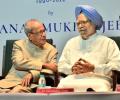
What Shekhar Gupta would have really liked to know from Pranabda: Why did Sonia prefer Dr Singh to him as PM? Why did he deny finance first, why did he accept it 5 years later, and why did he make such a mess of it? How did he force Sonia to nominate him for President and not Hamid Ansari? And how does he justify that most toxic legacy -- the Vodafone tax amendment?

'...only if we sort it out with Pakistan.'

Vinod Mehta, Editor-in-Chief of Outlook magazine, is one of India's best-known journalists. His remarkably candid autobiography, Lucknow Boy: A Memoir, offers a ringside view of many major events in recent times, brims over with wit, wisdom, scandal and gossip. Here, Vinod Mehta recounts his encounters with Sonia Gandhi: An intimate portrait of the rectient Congress leader.

The President in his book,The Turbulent Years:1980-9, has written about the conversation he had with Rajiv Gandhi in a bathroom about prime ministership.

The 79-year-old widely respected and popular leader steered the Congress in 2017 to a landslide victory in the 117-member assembly to occupy the chief minister's post for the second time.

President Pranab Mukherjee said he had no role in Singh's exit as RBI Governor.
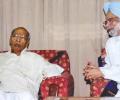
'Narasimha Rao asked me why China was doing so well in attracting foreign investments and I gave my frank opinion.' 'I told him that giving thrust to exports had to be a national effort.' 'But in India, the system was very centralised in the Government of India and the state governments had no role to play.'

The 84-year old veteran Congressman, who died from post-COVID complications on Monday, was a Nehru-Gandhi family loyalist.

Does Pranab Mukherjee want to be 'PM' by office, not just by initials? The very prospect, with memories of the Narasimha Rao years scarred into their memories, scares the Nehru-Gandhis, says T V R Shenoy.
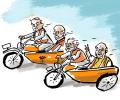
'Like in cricket, M S Dhoni was the captain and Virat Kohli played under him.' 'Then Dhoni played under Kohli.' 'Now imagine, having a second switch.' 'That is the analogy here, and I find no other example in Indian politics, or even world politics.'

Former prime minister Manmohan Singh's daughter Daman Singh, who has penned her parent's biography, said it was "upsetting" that the public opinion had turned against him towards the end of his 10-year rule.

'The mobilisation is nothing but a political ploy -- a sort of a fixed match between Hindu and Muslim communal forces, towards polarisation, in a run-up to the next election,' argues Mohammad Sajjad.
We need credible retellings of the times we have lived through, or the events in the immediate past that have shaped our today, says Mihir S Sharma
